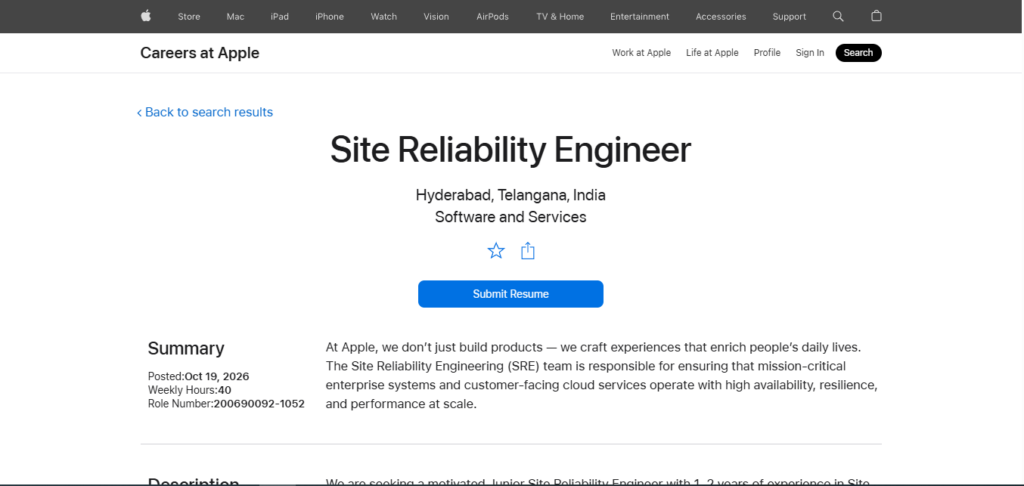
Apple announced job vacancy for the post of Junior Site Reliability Engineer. The place of posting will be at Hyderabad. Candidates who have completed Bachelor’s degree or foreign equivalent in Computer Science, Computer Engineering, Information Technology, or a related field with 1–2 years of combined work experience in Site Reliability Engineering (SRE), Application Production Support (APS), DevOps, or Systems Engineering are eligible to apply. More details about qualifications, job description and roles & responsibilities are as follows
Company Overview
| Name of the Company | Apple |
| Required Qualifications | Graduate |
| Skills | AWS, GCP, or Azure |
| Category | Software and Services |
| Work Type | Onsite |
They are seeking a motivated Junior Site Reliability Engineer with 1–2 years of experience in Site Reliability Engineering (SRE), Application Production Support (APS), DevOps, or Systems Engineers to join our fast-paced, agile engineering team. In this role, you will help maintain application reliability by investigating production incidents, troubleshooting application and database issues, resolving data pipeline failures, and identifying performance bottlenecks through root-cause analysis.
You will collaborate with development, QA, database, data, and infrastructure teams to improve service reliability, automate operational tasks, and support modern observability practices, including AI service traceability and dependency monitoring.
Job Details
Θ Positions: Junior Site Reliability Engineer
Θ Job Location: Hyderabad
Θ Salary: As per company standards
Θ Job Type: Full Time
Θ Requisition ID: 200690092-1052
Roles and Responsibilities:
- High-Availability Operations: Monitor the health, performance, and capacity of mission-critical applications and services across multi-region environments.
- Incident Triage & Response: Act as a first-line responder to production alerts, outages, and system anomalies, participating in on-call rotations and rapid-response workflows.
- End-to-End Troubleshooting: Investigate and debug complex application, core system, network, and performance bottlenecks through to resolution, including environment-specific issues and differences between staging, experimental, and production configurations.
- Database Diagnostics: Perform database-level troubleshooting, query analysis, data verification, and performance tuning across PostgreSQL, Oracle DB, and MySQL environments. Troubleshoot ETL jobs and data pipelines, investigate processing failures, and diagnose data availability issues across relational, NoSQL, and Snowflake environments.
- Root-Cause Analysis (RCA): Partner with development, QA, database, and infrastructure teams to identify underlying root causes and implement permanent fixes.
- Observability & Alerting: Build and refine telemetry dashboards, log aggregations, and alerting rules using tools such as Splunk, Prometheus, Grafana, and Dynatrace. Use Langfuse and LangSmith where applicable to investigate AI traces, identify failures, and monitor service dependencies.
- Service Level Tracking: Track and uphold key reliability metrics (SLIs/SLOs) to minimize Time to Detect (TTD) and Time to Mitigate (TTM). Monitor AI model latency, token consumption, API quotas, and dependency health, with alerts for defined performance thresholds, including the sub-500 ms target where applicable.
- Toil Reduction & Automation: Develop robust scripts and tools using Python, Bash, or similar languages to automate repetitive operational tasks, health checks, and routine maintenance.
- Release & CI/CD Enablement: Support production deployments, CI/CD pipeline runs (Jenkins, GitHub Actions), build validations, and canary/smoke testing.
- Change & Configuration Governance: Execute production change requests (CRs) in accordance with enterprise change management and risk assessment standards. Support environment configuration validation, service provisioning runbooks, certificate renewals, and secure secrets management.
- Continuous Improvement & Modern Tooling: Leverage modern engineering practices and GenAI-assisted workflows to accelerate log analysis, incident documentation, and operational efficiency.
Required Skills & Qualifications:
- Bachelor’s degree or foreign equivalent in Computer Science, Computer Engineering, Information Technology, or a related field.
- Experience: 1–2 years of combined work experience in Site Reliability Engineering (SRE), Application Production Support (APS), DevOps, or Systems Engineering.
- Linux Fundamentals & System Engineering: Solid understanding of Linux/Unix internals, including filesystems, process management, networking, permissions, system services, and resource utilization.
- Application & Programming: Knowledge of programming languages such as Java and Python, with the ability to read code, debug applications, and write scripts to automate operational tasks.
- Database Troubleshooting: Strong debugging and querying skills with relational databases such as PostgreSQL, Oracle DB, and MySQL, along with familiarity with NoSQL databases, Snowflake, ETL, and data pipeline troubleshooting.
- Observability & Monitoring: Familiarity with logging, monitoring, and observability platforms such as Splunk, Grafana, Prometheus, and Dynatrace. Knowledge of AI traceability tools such as Langfuse and LangSmith is beneficial.
- Incident & Change Management: Understanding of incident triage, production issue resolution, root-cause analysis, and standard change and configuration management processes.
- CI/CD Foundations: Basic understanding of CI/CD concepts and continuous deployment tools such as Jenkins and GitHub Actions.
- Modern Technology & AI Operations: Familiarity with GenAI solutions, AI models, and AI-assisted workflows. Ability to troubleshoot AI dependencies, including model availability, token consumption, API quotas, rate limits, and latency. Understanding of alerting against defined latency objectives, including a sub-500 ms target where applicable, and troubleshooting staging or experimental environments that differ from production.
- Operational Reliability & Security: Ability to follow provisioning and recovery run books, troubleshoot environment configuration issues, and support certificate renewals, certificate expiry monitoring, and secrets management.
Preferred Qualifications
- Containers & Orchestration: Hands-on experience with Docker containers and foundational knowledge of Kubernetes concepts.
- Cloud Infrastructure: Familiarity with public or private cloud platforms (AWS, GCP, or Azure).
- Security Operations (SecOps): Basic knowledge of security operations, certificate lifecycle practices, and secure configuration management.
- SIEM & Security Monitoring: Familiarity with SIEM tools for monitoring security events, investigating alerts, and identifying suspicious activity.
- AI-Assisted Operations: Ability to leverage AI/ GenAI tools to accelerate log analysis, script generation, and issue investigation.
- Infrastructure as Code (IaC): Basic awareness of configuration and infrastructure automation tools such as Ansible and Terraform.
How to Apply
Apply Link – Click Here
For Regular Updates Join our WhatsApp – Click Here
For Regular Updates Join our Telegram – Click Here
Disclaimer:
The information provided on this page is intended solely for informational purposes for Students, Freshers & Experience candidates. All the recruitment details are sourced directly from the official website and pages of the respective company. Govtjobmart do not guarantee job placement, and the recruitment process will follow the company’s official rules and Human Resource guidelines. Govtjobmart do not charge any fees for sharing job information. Govtjobmart strongly advise Students, Freshers & Experience candidates not to make any payments for any job opportunities.
