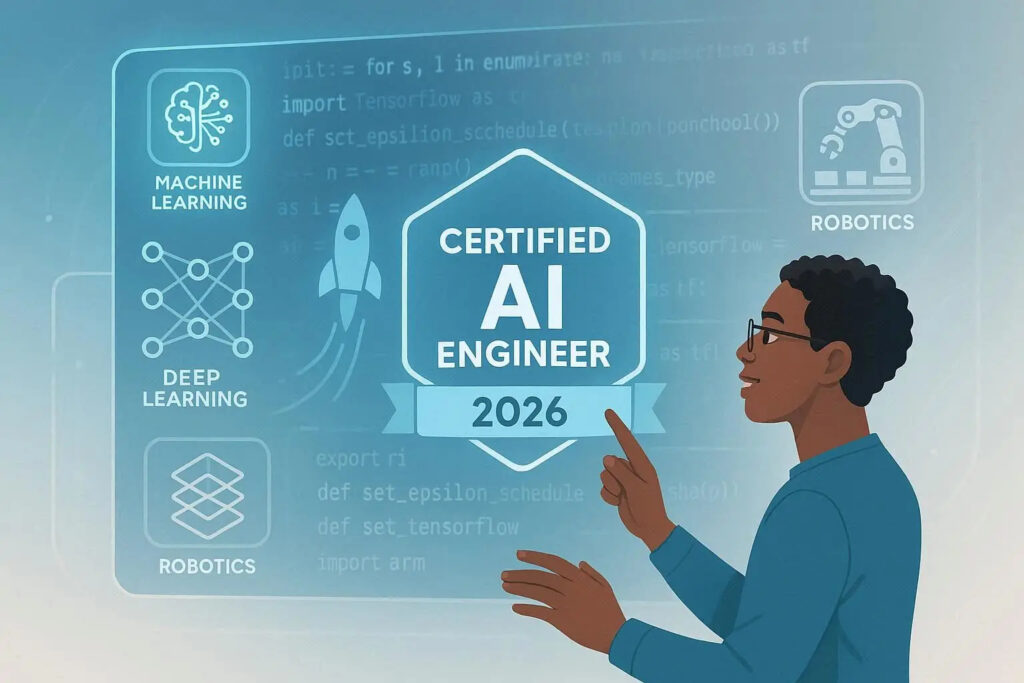
Artificial Intelligence (AI) has become the driving force behind innovation across industries, reshaping how businesses operate, scale, and compete globally. By 2026, AI is no longer limited to research labs or tech giants—it is embedded in everyday applications such as chatbots, recommendation engines, fraud detection systems, medical diagnostics, autonomous vehicles, and smart manufacturing. This rapid adoption has made AI Engineer certification programs in 2026 one of the most sought-after learning paths for students and professionals alike.
An AI Engineer certification for high-paying roles validates your expertise in designing, developing, and deploying AI-driven solutions. With organizations prioritizing automation and intelligent systems, certified AI Engineers are positioned at the forefront of the tech job market. This article explores the importance, benefits, career scope, salary trends, certifications, and demand outlook for AI Engineer certification programs in 2026.
Importance of AI Engineer Certification in 2026
As AI systems become more complex and mission-critical, companies are increasingly selective about hiring professionals with proven skills. AI Engineer certifications play a crucial role in bridging the gap between theoretical knowledge and practical application.
In 2026, certification programs are important because they:
- Validate hands-on expertise in machine learning and deep learning
- Demonstrate understanding of real-world AI use cases
- Ensure familiarity with modern AI frameworks and tools
- Help professionals stay updated with rapidly evolving technologies
An advanced AI Engineer certification for professionals signals credibility and technical competence, making candidates more competitive in a crowded job market.
Key Benefits of AI Engineer Certification Programs
Pursuing an AI Engineer certification offers multiple long-term advantages:
1. Structured Learning Path: Certifications provide a clear roadmap, covering core AI concepts from fundamentals to advanced applications, reducing confusion caused by scattered learning resources.
2. Industry-Relevant Skills: Most AI Engineer certification programs in 2026 focus on practical implementation, enabling learners to build, train, evaluate, and deploy AI models.
3. Career Growth and Stability: AI skills are future-proof. As automation increases, AI Engineers will remain in high demand, ensuring long-term career stability.
4. Global Recognition: AI certifications are globally relevant, allowing professionals to explore opportunities across international markets.
Career Scope of AI Engineers in 2026
The career scope for AI Engineers in 2026 is vast and expanding rapidly. Almost every industry is integrating AI to improve efficiency, accuracy, and decision-making.
Popular Job Roles After AI Certification:
- AI Engineer
- Machine Learning Engineer
- Deep Learning Engineer
- Computer Vision Engineer
- Natural Language Processing Engineer
- AI Research Engineer
Industries Actively Hiring AI Engineers:
- Information Technology & Software
- Healthcare & Medical Technology
- Banking, Finance & FinTech
- Automotive & Autonomous Systems
- Retail & E-commerce
- Cybersecurity & Defense
With AI adoption accelerating, professionals with a recognized AI Engineer certification program can explore diverse and high-impact roles.
Salary Trends for AI Engineers
AI Engineering consistently ranks among the highest-paying tech careers. In 2026, salaries are expected to rise further due to the global shortage of skilled AI professionals.
Estimated Salary Range (India – 2026):
- Entry-Level (0–2 years): ₹8 – ₹14 LPA
- Mid-Level (3–6 years): ₹18 – ₹30 LPA
- Senior-Level (7+ years): ₹40 – ₹70+ LPA
Global Salary Outlook:
- USA: $110,000 – $180,000 per year
- Europe: €75,000 – €130,000 per year
Professionals with an AI Engineer certification for high-paying roles often progress faster into senior and specialized positions.
Core Skills Covered in AI Engineer Certification Programs
A comprehensive AI Engineer certification in 2026 typically focuses on both theoretical foundations and real-world applications.
Key Technical Skills Include:
- Python programming for AI
- Machine Learning algorithms
- Deep Learning and Neural Networks
- Natural Language Processing (NLP)
- Computer Vision
- Model deployment and optimization
- AI ethics and responsible AI
Programs that emphasize hands-on projects and real-world datasets help learners build strong portfolios.
Demand Outlook for AI Engineers in 2026
The demand for AI Engineers is expected to grow exponentially through 2026 and beyond. Organizations are increasingly relying on AI for automation, predictive analytics, and intelligent decision-making.
Key factors driving demand include:
- Rapid adoption of generative AI
- Increased use of AI in healthcare and finance
- Expansion of autonomous systems
- Integration of AI with cloud and edge computing
An AI Engineer certification program in 2026 equips professionals to meet these evolving industry demands.
Who Should Pursue AI Engineer Certification?
AI Engineer certification programs are ideal for:
- Engineering and computer science graduates
- Software developers aiming to specialize in AI
- Data professionals transitioning into AI roles
- Working professionals seeking high-growth tech careers
Even beginners can enter the AI field with the right foundational training and consistent practice.
Conclusion
AI Engineer certification programs in 2026 represent a powerful gateway into one of the most innovative and high-paying careers of the decade. As AI continues to redefine industries, certified professionals will play a crucial role in shaping intelligent systems that drive business success and societal progress.
By pursuing a professional AI Engineer certification for high-paying roles, learners gain future-ready skills, global career opportunities, and long-term growth potential. Whether you are starting your career or upgrading your expertise, investing in AI education today can deliver exceptional rewards tomorrow.
